August in Review - Film Edition:
- Kate McGarry
- Aug 31, 2023
- 9 min read

An overview of all the films I watched this month.
Feature Films:

God's Creatures:
Physiological Thriller - 1hr 41 min - BFI Player
God's Creatures stars Paul Mescal and Emily Watson as mother and son Brian and Aileen. Brian has come home from Australia to work in the oyster fields. Soon after, he is accused of sexual assault by a childhood friend. It is clear that Brian is guilty, but his mother lies on the stand, providing Brian with an alibi for the night of the attack. The film deals with the lengths we go to protect our loved ones, particularly about the bond between mother and son and how some have a strange quality to them. The film is perfectly slow-paced; it is in the imperceptible moments of the mundanity of Ailleen folding away Brian's laundry, waking him up in the morning, making him breakfast, almost treating him like a child, and dressing up for each other to go out to the pub, we get this sense of unusual closeness. All these small moments give us a slight uneasiness, amplified by the location. The film is set in a small Irish village where it seems all the inhabitants are employed in the fishing industry. The men work out at sea, and the women work in the factory processing the men's catch. The villagers have a tradition of not teaching their children how to swim so when they eventually go out to sea; they won't risk their lives to save someone if they are drowning. The village feels intensely claustrophobic and as though its people are servants to the sea. Of course, Paul Mescal and Emily Watson provide outstanding performances. At the start, the film is a little frustratingly slow, but if you stick with it is worth the wait. After I finished, I found the film so affecting I couldn't stop thinking about how the film put the work in at the beginning to create such an affecting ending. If it wasn't clear already, God's Creatures is a must-watch.

All My Friends Hate Me:
Comedy Horror - 1hr 33 min - BFI Player
All My Friends Hate Me is a dark comedy/horror written by British comedy duo Tom Palmer and Tom Stourton, who also plays the lead, Pete. The film revolves around Pete, who reunites with his upper-class university friends at a large country home for Pete's birthday. But once a new member of the group is introduced, tensions rise. The audience witnesses the unfolding events through Pete's lens, how his social anxieties and paranoia affect his interactions. As each conversation becomes increasingly alienating and certain events occur without explanation, Pete believes this new group member is out to get him. The genius of the film is in its writing. The film expertly toes the line between comedy and horror. The writers are playing on the audience's awareness of the 'Eat the Rich' trope evidenced in films such as Hostel, The Pruge or The Hunt. Has Pete been brought to a secluded country manor to be a chess piece in some twisted game, or is it actually for his birthday? Sometimes, the film is cringe-inducing, but you can't look away because you need to know whether Pete's interpretation of events is real. The film is a testament to the complexity of human interaction whilst also being a cautionary tale of how the social dynamic of banter and pranks can be toxic, perfectly summed up by the final line of the film said to Pete, "You know the problem with you don't you? You can't take a fucking joke".
Boiling Point:
Drama - 1hr 32 min - Netflix
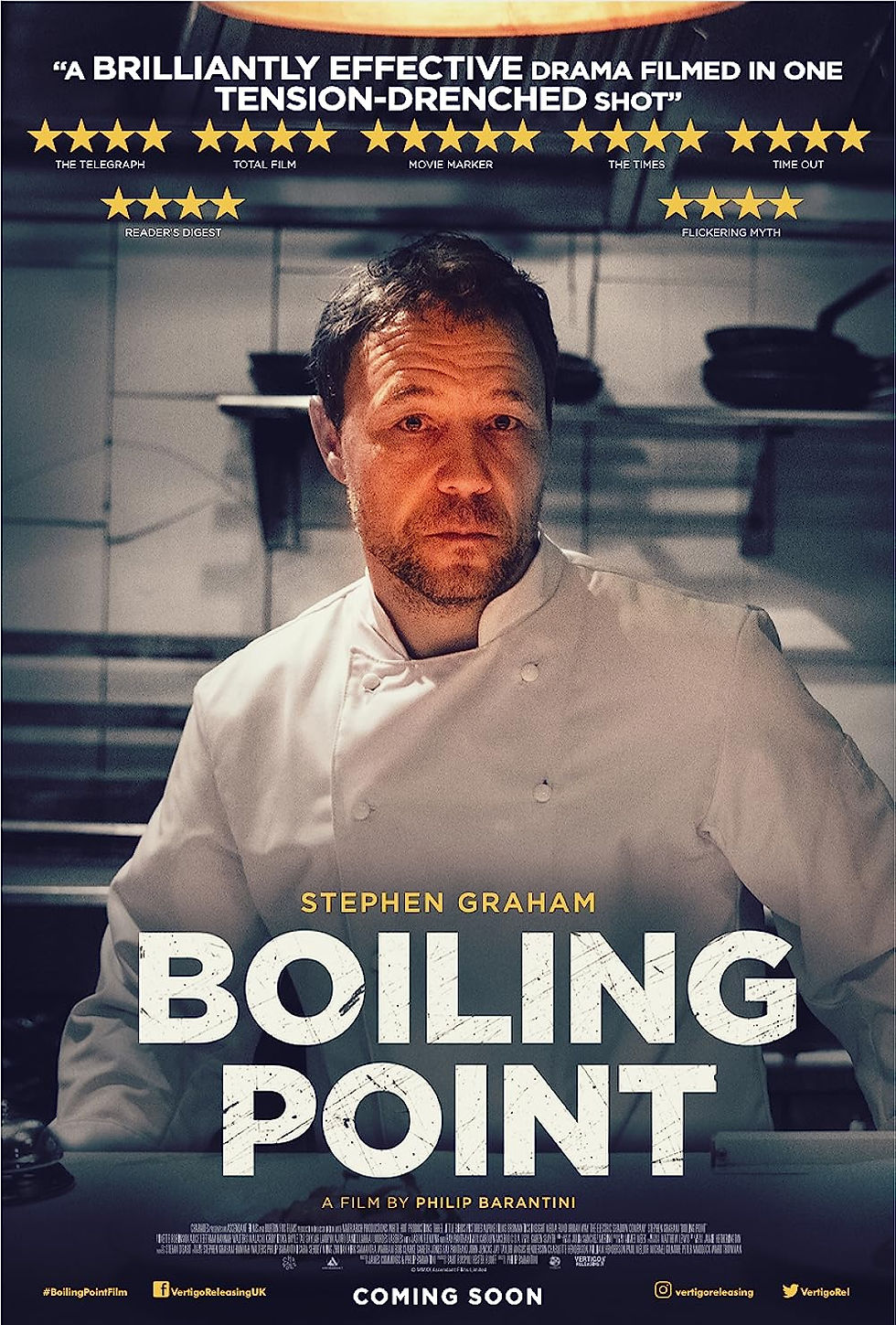
Boiling Point is a single-shot film about the high-intensity atmosphere of a restaurant kitchen. The film is an authentic single take with no hidden cuts anywhere, so it is a huge cinematic feat. After finishing The Bear, I wanted more, but with no third series to jump into, I turned to Boiling Point, and it did not disappoint. The single shot places you amongst the action and heightens the intensity as the events play out in real time. In an hour and thirty minutes, the film deals with a lot, racist guests, self-harm, nepotism, drug addiction, financial issues, health inspections, marital breakdowns, food reviews, medical emergencies and more. The film is perfectly paced, and the huge amounts of plot points don't feel rushed or too overwhelming. Boiling Point is a fantastic example of no small parts. Stephen Graham gave such a powerful performance, but everyone surrounding him needed to be on their A-game, too, even the extras shoved on the table in a dark corner by the toilet. Which they did; in the short time we spent with the cast of characters, we got a glimpse into each of their lives and an intimate insight into the restaurant's ecosystem. Boiling Point is an outstanding piece of cinema, but for films that are done in a single take, I do question the need to do so. It is amazing to show that it is possible, but what does it do to serve the storytelling? Yes, we got a real-life depiction of service in a restaurant, but because it was fast-paced, it emulated the supercharged nature of the industry. But by doing so, we lost some heart to the storytelling. Saying this is probably redundant because it was not possible in the scope of a single take, but I felt a disconnect to the characters, and just sitting with them for a few more beats, I think, would help certain plot points have more depth and feel less surface level. Nonetheless, I am excited about the TV series, which will air soon; I hope it will be more like The Bear, and hopefully, not every episode will be a single take, but if it is anything like the film, I am sure it will be great.
Short Films:
Although the feature film viewing may have been thin on the ground this month, I watched many short films. I won't go into detail on all the ones I watched, but there is a link to a YouTube playlist that features all the shorts I watched this month, so you can watch them, too.
August Shorts 2023:

First Chair:
Drama - 13 min
Jin is the first chair clarinet player at her music school, but when a new player, Nathan, enrols, he becomes her rival. Jin is a talented clarinet player who is quietly passionate about piano and songwriting. As her first chair position is at risk during chair reassignment week, Jin is seen practising harder and harder to keep her chair. Nathan is a sweet boy who tries to connect with Jin, but she can only see him as her competition. Until they share a sweet moment after Nathan catches Jin practising the song she wrote. Despite this, once Jin finds out she has kept her first chair, she ices Nathan out.
First Chair is an unassuming piece about academic success and the outside pressures that come with it. The film is all in the subtext and body language; there is very little dialogue. My take on the film is that Jin, of Asian heritage, most likely has familial pressures to become a successful clarinet player, even though she may secretly prefer to be a singer-songwriter. With the introduction of Nathan, she recognises that she may not be the best, so she has to work even harder and put her other passions aside. However, Nathan is a double threat who takes a liking to Jin, who, after the moment they share in the piano hall, realises that she can't let a boy ruin her focus.
The film is a quiet but successful piece with a tight narrative arc. The script is written by The Montgomery Brothers, who have created perfectly observed characters who don't lean into stereotypes. This exists in the same world as Whiplash or The Sound of Metal to some extent, but the protagonist, Jin, is not a ruthless or tortured musician. She quietly works away, practising for hours and hours to be the best at her craft. This may be the portrayal because she is a woman, and if The Montgomery Brothers chose to write a male character, this might be different, but who knows? The Montgomery Brothers also do a great job directing. This film is all about the small moments. The small acts of kindness Nathan demonstrates to help his classmate play better or the moments of reflection Jin has in her small practice room. All of these choices are effecting and create nuanced storytelling. First Chair is defined as a watch if you have seen it already.

James:
Drama - 14 min
James is about the first person to be vaccinated from smallpox. While looking for work with his father, James Phipps knocks on the door of a large country manor, where, unbeknownst to them, Doctor Edward Jenner resides. Jenner is working on the smallpox vaccine and asks James to be his test subject after giving Phipp's work in his garden. Firstly, James is given the cowpox, which Jenner believes will cause James to be immune from smallpox. But before James can be given the smallpox to test Jenner's theory, James' father ushers him away; he is willing to go hungry if it means he doesn't lose another child to smallpox. However, James understands his family is starving, and if he doesn't help to test the theory, then his family will have to wait till harvest to find work and potentially eat. So James returns to the house without his father and becomes the first person in English history to vaccinate against smallpox.
Having very little knowledge about the eradication of the smallpox disease, James was a great insight. It is a testament to short film storytelling that such a monumental historical event can be told so eloquently and effectively in just 14 minutes. Despite the small amount of time we spend with these characters, we care for them. We understand the stakes at play and how scary it must be to live in a world where not only do you have to worry every day about where your next meal is coming from but also that at any moment, you could contradict this horrible disease and those you love can be taken in an instant. Jack Hollington and Morgan Watkins Portray this complicated father-son relationship so well. Hollington brings a wide-eyed innocence of childhood to his performance whilst also childlike curiousness, which allows him to understand the stakes at play. Watkins doesn't play into the distant father figure stereotype, and you can see the emotional strain of hard decisions in a single glance. The film is perfectly paced and allows for stillness to let the emotional beats play out. My only misunderstanding of the film is the metaphor if that is the right word, of the dying fox. Partway through the film, we see a dead fox as it is decaying, and before James goes back to the house alone, we cut to a fox in the bushes nearby. The moment does add an eerie quality to the film and perhaps is trying to liken James to the fox. A thing is seen as a nuisance to society or not worthy, but to see the fox alive is like he is reborn and is worthy. I am not sure I am explaining my thoughts well, but exploring the idea in this review has allowed me to understand it a little more. Besides that, James is a great little piece worth 15 minutes of your time.

Toast:
Drama - 13 min
Toast is set during the COVID-19 lockdown, and a young man is helping his elderly neighbour by doing his weekly shopping for him. The elderly neighbour is grumpy and upset when the young man can't get everything on the list, although the young man is going out of his way to help. Despite the unwelcome reaction each time the young man drops off the shopping, he is not deterred and continues to try and connect with his neighbour. After an off-handed comment about missing the pub, after the young man couldn't get the elderly man some beer, the young neighbour sets up a makeshift pub in the garden. The two spend the night drinking and talking to one another, and the elderly finally opens up and thanks the young man for all he has been doing for him. However, the next time the young man goes over, the elderly man doesn't open the door and is later rushed to hospital.
Toast, although a bit kitsch, is a sweet story and an essential reflection on lockdown. This short film is in a long line of COVID-19 content, and despite its tragic end, it does not dwell on the hardships of the time. Instead, I would categorise it as a majority depiction of the time. A large portion of the population was shopping weekly for a loved one who may have been vulnerable. But even being careful, Covid-19 was so aggressive that you could still be susceptible despite how cautious you were. The film describes itself as a dramedy, and though not overly comedic, the camera work lends itself to the comedic and gives the film a slightly stylised feel. The two leads, Harry Walters (Young Man) and Roger Solman (Elderly Neighbour), play off each other well. Walters brings joviality to his performance, which, in other instances, might be overplayed or offputting, but his performance is pitched perfectly. Solman is an excellent piece of casting for this character. You can tell the lockdown annoys him rather than anything to take too seriously. You can imagine him being quite spritely and sociable outside of this context, and being locked inside is getting to him as he has lost his independence. And that annoyance is coming out when the ability to buy his shopping the way he wants is taken away. Overall, this is a great little film.


Comments